Islamic Republic of Iran

Ministry of Foreign Affairs

Agha Bozorg mosque and school building are one of the most magnificent and beautiful mosques of Qajar era in Iran that is established by Haj Mohammad Taqi Khanban invest for prayer and discussion by his son-in-law, Mullah Mahdi Naraqi II, known as Agha Bozorg during 1250 to 1260 years.

The Complex of Armenian churches, some nearby buildings and Dare Sham village are the elements of cultural exchange between Orthodox Byzantine and Iranian culture.
Located at the end southeast of the Armenian cultural domain, these churches became the center of Armenian cultural dissemination in Azerbaijan of Iran and they are currently preserved under good conditions.

Chak Chak Fire Temple (Pir-e Sabz, Chakchaku) is one of the most important shrines of the Zoroastrians in the mountain enjoyed a special reputation and many Zoroastrians come and pray in this place from 24 June for four days every year. Mehregan festival is held at this place every year. According to legends, this place has been the heaven of the daughter of Yazdgerd (Sassanid king), Nik Bano, from the Muslims.

Emad ud-Duleh Mosque is a unique building with a special spatial location. This mosque is placed in the center of Kermanshah city, inside the traditional bazar, just in the center of the gathering place. Kermanshah is located in a border region and is accordingly a land of different beliefs, the intersection of two cultures from two neighboring countries with the presence of different religions. These features made the mosque to be a place for gathering different classes. The architecture of the building shows also for its public utility. 

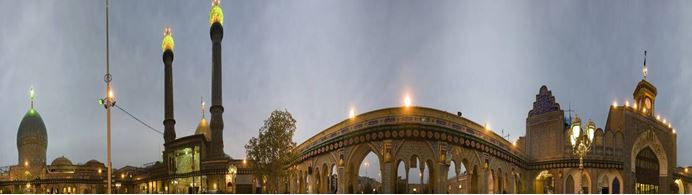
Qom is resting place of the 7th Imam of Shia, Imam Mousa Kazem’s (PBUH) daughter, Hazrat Masumeh (PBUH). This magnificent building is located in the center of the city and the history of the building back to the third century AH.

This temple is built in 1310 SH by Indian merchants of Shikarpur city in the west of India, for the Hindus who lived in Bandar Abbas and were busy with commerce during Mohammad Hasan Khan Sa’ad al-Malek reign since 1300 to 1344 SH.

Imam Reza’s (PBUH) holy shrine is the biggest, most important and prominent religious center of Iran that consists of the most features of Persian-Islamic architecture that many pilgrims from Iran and all around the world go to this place every year.

Bibi Hakime (peace be upon her) mausoleum, the burial place of the seventh Shia Imam’s daughter, Imam Musa al-kadhim (peace be upon him) and the sister of Imam Reza (peace be upon him) is the most famous Imamzadeh in the south of Iran which is located in the depth of impassable southern Zagros mountains.

nown as one of the most important and among the earliest religious buildings in Iran, Masjed-e Jāmé of Isfahan is a magnificent and exquisite, artistically and technically significant monument, which embraces several phases of Islamic architectural development.

Masjed-e Jame of Saveh is one of the first mosques built in Iran and is considered as one of the valuable works of art, architecture, painting, tiling and stucco, which are all made of mud brick.

Masjed-e Jame of Varamin is one of the most valuable and finest Islamic architecture and one of the prominant mosques in Iran and Asia.Masjed-e Jame of Varamin building was built by the attempt of Sultan Mohammad Khodabandeh (Oljato), one of the most famous Mugol rulers in the Illkhani era.

Nasir al-Mulk Mosque (Persian: مسجد نصیر الملک, Masjed-e Nasir ol-Molk) is a construction with a marvelous architecture in the city of Shiraz in Fars province, which takes every viewer’ breath away with its play of light. Nasir al-Mulk Mosque is one of the architectural buildings of the Qajar period (1789-1925). It was built by the order of Mirza Hassan Ali Khan Nasir al-Mulk, the son of the rulers of Persia in the Qajar period. The area of Nasir al-Mulk Mosque is 2980 square meters. 

Firstly, the Abdol Azim holy shrine like all the other major shrines was just the central building contain the central part, but the other buildings constructed and linked to the main building during the years to finally reached to current form consisted of shrines, porch, mosque, courtyard and other relevant places.

Shah Cheragh is a famous holy shrine of Imam Mousa Kazem's (7th Shia Imam) son, Mir Seyed Ahmad, who is the brother of Imam Reza (peace be upon him), many Shias go to Shiraz for pilgrimage this place and it is one of the most significant sights of this city.

Tarikhane (means God's house, the house of God) is one of the Damghan heritages, before the domination of Arabs in Iran, which initially was a fire temple and then turned into a mosque over the centuries and has been repeatedly repaired.

Vank cathedral or Amena Pergic, the largest and most beautiful cathedral in Isfahan’s Julfa, one of the historical Armenian cathedrals, was established in the Shah Abbas II era in the lands of Zereshk garden in 1605; it was extended continuously during 50 years and finally reached to the current form.

Bahram fire temple Or Vararam fire temple in Yazd is one of the premises of the Zoroastrians, consisted of buildings and tree-lined garden that has been made in recent centuries. This building construction dated back to Pahlavi I era its architecture derived from the Achaemenid art. The main building is located in the middle of the courtyard and surrounded by tall cypress, pines and evergreen trees. A large circular pool at the center of entrance makes a certain beautiful site where the Zoroastrians and tourists throw coins into it according to an old tradition.